


 Contact us on WhatsApp:
Description
Manjushree, also spelled Manjushri, is one of the most revered and important bodhisattvas in Mahayana Buddhism. He symbolizes wisdom, knowledge, and insight, which are essential qualities for attaining enlightenment. Known as the Bodhisattva of Transcendent Wisdom, Manjushree is regarded as the embodiment of Prajñā (Sanskrit: supreme wisdom) — the insight that cuts through ignorance and reveals the true nature of reality.
In Sanskrit, “Manju” means gentle, lovely, or beautiful, and “Shree” means glory or brilliance. Thus, Manjushree can be translated as “Gentle Glory” or “Beautiful Splendor.” He is highly respected among Buddhists of Tibet, Nepal, China, and Japan, and his image or thangka is often found in monasteries, temples, and meditation halls where practitioners seek clarity of mind and intellectual understanding.
Manjushree’s Iconography
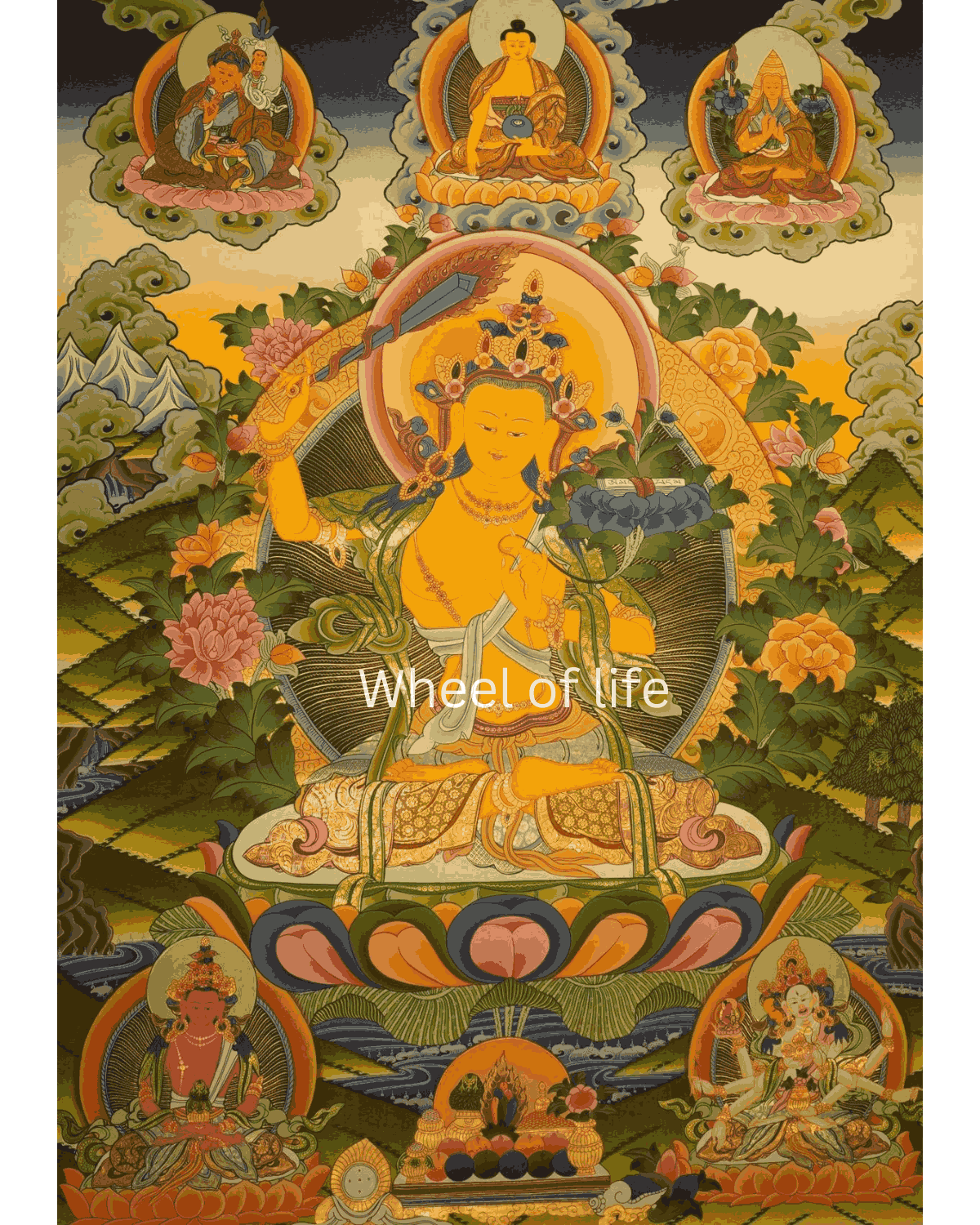
In Buddhist art, Manjushree is depicted as a youthful bodhisattva, symbolizing the eternal freshness of wisdom. His most distinguishing feature is the flaming sword (Khadga) that he holds in his right hand. This sword represents the power of wisdom that cuts through the darkness of ignorance and delusion. The flames on the sword signify the light of knowledge that destroys false views and misconceptions.
In his left hand, Manjushree holds a lotus flower (Padma), upon which rests a Prajñāpāramitā Sūtra, the “Perfection of Wisdom” text — one of the most profound teachings of Mahayana Buddhism. This symbolizes the union of wisdom and compassion, and the understanding that enlightenment is reached through the realization of emptiness (śūnyatā).
Manjushree often sits in a cross-legged lotus posture (padmasana), calm and serene, symbolizing his meditative state. His ornaments, including a crown, earrings, and silk garments, represent his status as a bodhisattva who remains in the world to guide sentient beings while embodying transcendental wisdom.
Manjushree’s Role and Symbolism
Manjushree represents wisdom (prajñā), one of the six perfections (pāramitās) that lead to enlightenment — the others being generosity, morality, patience, effort, and meditation. He is said to possess insight into the true nature of all phenomena, realizing the emptiness and interdependence of all things.
In Buddhist philosophy, ignorance (avidyā) is considered the root of suffering. Manjushree’s flaming sword is the weapon that destroys this ignorance, helping practitioners to see things as they truly are — impermanent, non-self, and interdependent. His teachings encourage critical reflection and meditative insight, guiding followers toward wisdom that transcends conceptual thinking.
Manjushree is also associated with eloquence and learning. Many monks, scholars, and students pray to him before studying or teaching Buddhist philosophy, hoping for clarity of mind and sharp understanding. Reciting his mantra is believed to enhance memory, intelligence, and spiritual realization.
Manjushree and the Origin of Kathmandu Valley
In Nepalese tradition, Manjushree holds a special place in the mythical origin of the Kathmandu Valley. According to ancient legends, the valley was once a large lake called Nagadaha or Swayambhu Lake. Manjushree, visiting from China or Tibet, saw a brilliant flame (symbol of enlightenment) shining from a lotus in the middle of the lake at Swayambhu Hill. To make this sacred site accessible to humans, he cut a gorge at Chobhar with his sword, allowing the water to drain and forming the fertile valley of Kathmandu. Because of this compassionate act, Manjushree is regarded as the founder and civilizer of the Kathmandu Valley.
This story highlights not only his wisdom but also his compassionate action for the benefit of living beings. Many shrines, including the Swayambhunath Stupa and Manjushree Hill near Chobhar, are dedicated to him in Nepal.
Mantra of Manjushree
Manjushree’s most well-known mantra is:
“Om A Ra Pa Ca Na Dhih”
Each syllable of this mantra represents a stage of wisdom and learning. Chanting this mantra is believed to clear the mind, remove ignorance, and bring clarity, insight, and understanding. The final syllable, “Dhih”, is especially powerful and represents the seed syllable of Manjushree’s enlightened mind.
Spiritual Significance
Meditating on Manjushree or visualizing his image helps practitioners cultivate wisdom and insight. He teaches that true wisdom is not merely intellectual knowledge but the direct realization of emptiness — understanding that all things lack inherent existence and arise due to causes and conditions. This insight leads to compassion and liberation from suffering.
In this sense, Manjushree represents the balance between wisdom and compassion, the two wings that enable one to reach enlightenment. His youthful form reminds us that true wisdom is ever fresh, dynamic, and open-minded.
Conclusion
Manjushree is not only a symbol of divine wisdom but also a compassionate guide who helps beings overcome ignorance and confusion. His teachings, iconography, and legend inspire millions of Buddhists around the world. In art, philosophy, and meditation, Manjushree remains a timeless reminder that enlightenment comes through the cultivation of insight, clarity, and understanding.
Whether seen as a historical myth or a spiritual archetype, Manjushree continues to illuminate the path of wisdom — the light that leads from darkness to awakening.
Estimated Arrival





Customer Reviews
There are no reviews yet.