


 Contact us on WhatsApp:
Description
White Tara, known in Sanskrit as Sitatara and in Tibetan as Drolkar, is one of the most beloved and revered female Bodhisattvas in Mahayana and Vajrayana Buddhism. She is considered the embodiment of compassion, long life, healing, and serenity. White Tara is regarded as a peaceful and motherly manifestation of Tara — the “Mother of all Buddhas” — who protects sentient beings from physical and spiritual suffering.
Origin and Meaning
The word Tara means “the one who liberates.” She is a savior goddess who helps beings cross the ocean of suffering (Samsara) to reach enlightenment. While Green Tara represents active compassion and protection from external dangers, White Tara symbolizes purity, longevity, and healing. Her white color signifies purity, wisdom, and truth. It also represents the radiance of the clear mind, untainted by ignorance or attachment.
According to Buddhist tradition, Tara was born from the compassionate tears of Avalokiteshvara (Chenrezig), the Bodhisattva of Compassion. When Avalokiteshvara wept upon seeing the immense suffering of all beings, a tear from his right eye manifested as Green Tara, and a tear from his left eye became White Tara. Thus, she is the compassionate mother who nurtures and heals all living beings with her peaceful energy.
Iconography and Symbolism
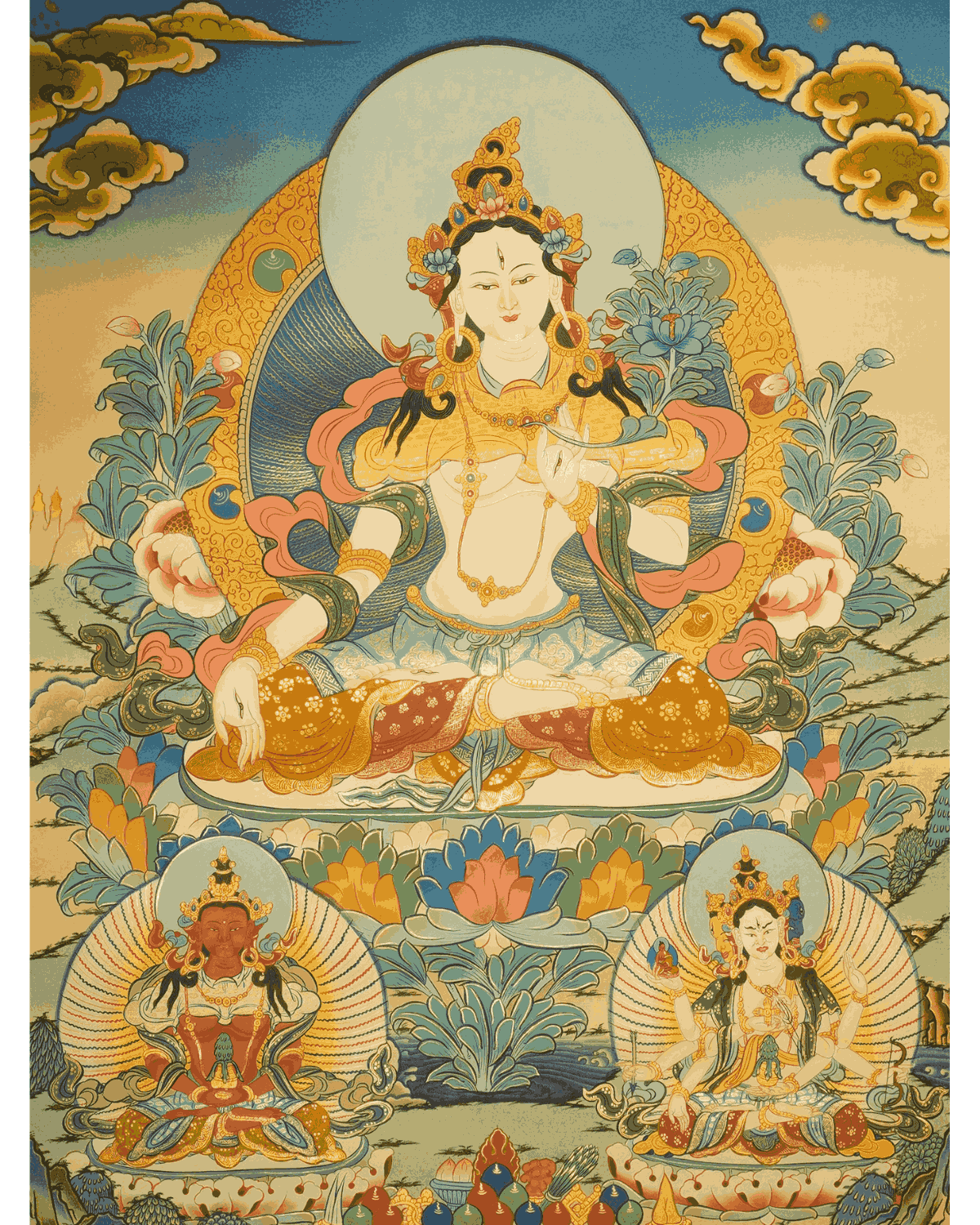
White Tara is usually depicted as a beautiful, peaceful goddess seated in the lotus posture (Padmasana) upon a full-blown lotus flower. Her complexion is white, symbolizing purity, wisdom, and truth. Unlike Green Tara, who is in a posture of action, White Tara sits calmly, representing serenity and contemplation.
One of her most distinguishing features is her seven eyes — one on her forehead, two on her palms, two on her soles, and the usual two on her face. These seven eyes symbolize her omniscient awareness and compassion that watches over all beings in every direction. They also represent her ability to perceive the suffering of all beings and to guide them toward liberation.
She holds her right hand in the gesture of generosity (Varada Mudra), symbolizing her endless giving of blessings and protection. Her left hand is held in the gesture of refuge (Abhaya Mudra), often holding the Utpala (blue lotus) flower, representing purity and spiritual awakening.
Spiritual Significance
White Tara is mainly associated with health, healing, and longevity. Her energy is gentle and nurturing, making her the perfect embodiment of motherly compassion. Devotees often pray to her for recovery from illness, protection from danger, and the extension of life.
In Tibetan Buddhism, her mantra and meditation practices are used to purify negative karma, overcome obstacles, and achieve spiritual clarity. It is believed that meditating upon White Tara helps to increase vitality and strengthen the life force (prana). Her compassion is directed toward healing the suffering caused by physical illness as well as emotional and mental pain.
White Tara Mantra
The mantra of White Tara is one of the most well-known and recited in Buddhist traditions:
“Om Tare Tuttare Ture Mama Ayuh Punya Jñana Pushtim Kuru Svaha.”
This sacred mantra invokes White Tara’s blessings for long life, merit, wisdom, and spiritual growth. The meaning can be interpreted as:
-
“Om Tare Tuttare Ture” – calling upon Tara to remove suffering and obstacles,
-
“Mama Ayuh Punya Jñana Pushtim Kuru Svaha” – requesting an increase in life, merit, and wisdom.
Reciting this mantra with devotion is believed to bring inner peace, healing, and protection from premature death or misfortune.
Meditation Practice
In White Tara meditation, practitioners visualize her radiant white form seated above their head or in front of them. Her seven compassionate eyes radiate light, removing suffering and purifying the body and mind. This practice helps cultivate compassion, mindfulness, and awareness of impermanence. It also deepens one’s connection to the enlightened qualities of the divine feminine.
Through visualization and mantra recitation, practitioners align themselves with White Tara’s energy of infinite compassion and healing. Over time, this meditation is said to awaken the inner Tara — the inherent wisdom and compassion that resides within all beings.
Cultural and Artistic Importance
White Tara is widely represented in Thangka paintings, sculptures, and rituals across Tibet, Nepal, Bhutan, Mongolia, and other Buddhist regions. Her image is often placed on altars or given as a blessing to those who are ill or seeking spiritual support. Artists portray her with exquisite grace and serenity, symbolizing inner peace and purity. In many monasteries, White Tara pujas (rituals) are performed to pray for longevity of spiritual teachers and benefactors.
Conclusion
White Tara is the embodiment of divine compassion and healing light. She represents the peaceful and nurturing aspect of the enlightened mind, offering guidance, protection, and blessings to all beings. Her seven eyes see the suffering of the world, and her boundless compassion works to relieve it. Through devotion, meditation, and mantra recitation, practitioners connect with her pure energy to achieve long life, inner peace, and spiritual awakening.
In essence, White Tara is not only a goddess to be worshipped but also a mirror of our own pure and compassionate nature — reminding us that within every being lies the potential for enlightenment, wisdom, and unconditional love.
Estimated Arrival





Customer Reviews
There are no reviews yet.